|
Economy of care towards (in)equality of genders at work, employment and access to resource |
|
|
|
Banja Luka, 7 April 2010th
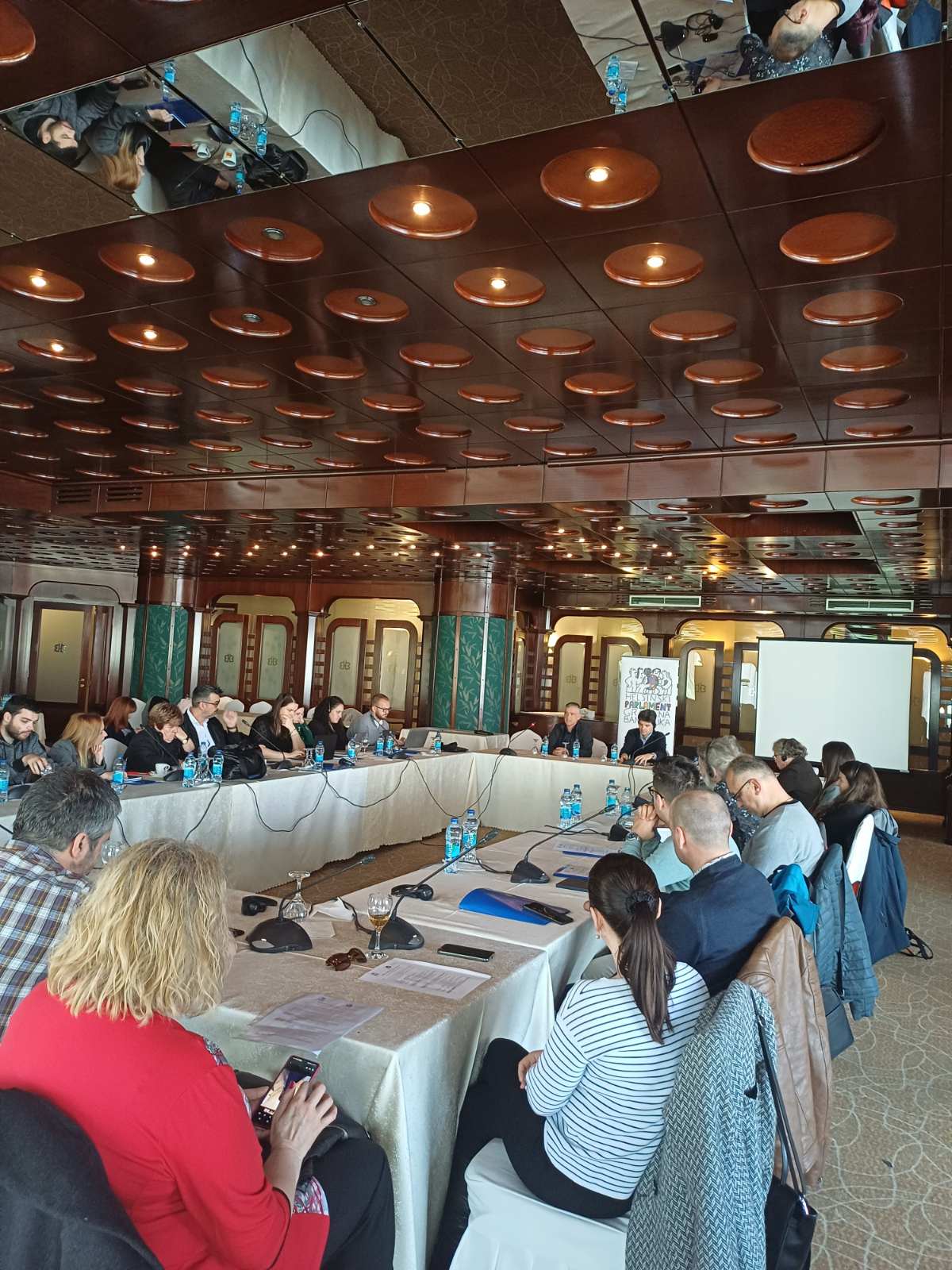
The consequences of the global economic crisis, which has not bypassed BiH either, is mostly affecting the poorest ones whose life depends on their work, so it is essential to invest additional effort to prevent the situation where the women will bear the biggest burden of the recession - this was emphasized at the forum entitled "Economy of care towards gender (in)equality at work, employment and access to resources ", organized by the United Women and the Helsinki Citizens' Assembly Banja Luka, with financial support from the Swedish Kvinna till Kvinna Foundation.
Economy of care, which includes both domestic and volunteer engagement of women, is not only undervalued, but this term is hardly known in this region, and certainly falls into one of the top topics related to gender inequality, said Nada Golubovic, Executive Director of United Women Banja Luka.
Jelena Milinovic, Head of the Department for Coordination, Education and Cooperation of the Gender Centre of the RS Government, recalled in her opening speech that throughout the entire history of human civilization, which is mainly based on the patriarchal system of values, women worked more than men in family households and in the external work engagement, and that their work has always been poorly recognized and paid less than men.
Among other things, she presented the data of Humphrey Institute of Public Affairs, saying that women represent 50 percent of world population, they perform nearly two-thirds of all working hours, but receive one-tenth of world income and own less than one percent of global assets.
B.M.
Banja Luka, 7 April 2010th
The consequences of the global economic crisis, which has not bypassed BiH either, is mostly affecting the poorest ones whose life depends on their work, so it is essential to invest additional effort to prevent the situation where the women will bear the biggest burden of the recession - this was emphasized at the forum entitled "Economy of care towards gender (in)equality at work, employment and access to resources ", organized by the United Women and the Helsinki Citizens' Assembly Banja Luka, with financial support from the Swedish Kvinna till Kvinna Foundation. Economy of care, which includes both domestic and volunteer engagement of women, is not only undervalued, but this term is hardly known in this region, and certainly falls into one of the top topics related to gender inequality, said Nada Golubovic, Executive Director of United Women Banja Luka. Jelena Milinovic, Head of the Department for Coordination, Education and Cooperation of the Gender Centre of the RS Government, recalled in her opening speech that throughout the entire history of human civilization, which is mainly based on the patriarchal system of values, women worked more than men in family households and in the external work engagement, and that their work has always been poorly recognized and paid less than men. Among other things, she presented the data of Humphrey Institute of Public Affairs, saying that women represent 50 percent of world population, they perform nearly two-thirds of all working hours, but receive one-tenth of world income and own less than one percent of global assets. B.M.
|
|
|
National Minorities Rights and Local Policies |
|
|
|
 29 March 2010
A local workshop on national minorities rights within municipal context was held as part of the regional project “Neighborhood – Affirmation of Multiculturalism and Cooperation at Municipal Level in the Countries of Western Balkans” in Banja Luka on March 25, 2010, which served, among other things, for presentation of publication “National Minorities Rights and Municipal Policies – A Study on the Application of Standards Regarding the Protection of Rights of National Minorities in BiH, Serbia, Croatia, and Slovenia”.
The publication is the result of months of research that was conducted from September to December 2009 in nine municipalities in Bosnia and Herzegovina, Serbia and Croatia, with the main goal to assess compliance with applicable local policy standards regarding protection of the rights of national minorities.
The research results were presented by the hCa activist, Maja Kremenović, and one of the researches, Željka Žolja, together with Radomir Šovljanski, the representative of Center for Regionalism from Novi Sad, and Mirjana Galo from Association for Protection of Human Rights and Civil Liberties “HOMO” from Pula.
In the introductory part of the workshop, the sociologist Slobodan Nagradić presented European documents that guarantee the rights of national minorities, and that BiH has ratified, and he also mentioned experiences of some European countries in the process of joining the European Union.
The aim of the workshop was to analyze the status and rights of persons belonging to national minorities in Banja Luka municipality, as well as policies and measures implemented by the local authorities within this context.
M.K.
Read more
|
|
26 March 2010
"Autism is a multidimensional phenomenon which is variously defined. Us, parents of children diagnosed with autism, are deeply hurt by having to watch our children pass through many traditional medical examinations that do not give any results and to be referred to the so-called experts that write off our children from the start,” said Goran Drakulić, Chairman of the Association for Supporting Persons with Autism “Children of Light ", at yesterday's branch with journalists held in Banja Luka,
"I can not accept the explanation of some specialists that my child is in some kind of armor that will never be broken. I'll find a door on the armor to coax him out", said Drakulic, adding that, unfortunately, our society is such that leaves the parents on their own, without any institutional support.
"What our egregious experts do when they are faced with a child who is behaving more aggressively? They prescribe antidepressants to calm them down, that is all they know, and this is utterly catastrophic", said Drakulic, adding that the there is a daily rise in the number of children diagnosed with autism in the world.
D.D.
Read more
|
|
Necessary to Harmonize Electoral Law in BiH |
|
|
|
|
10 March 2010
On the occasion of the announced amendments to the BiH Electoral Law, which will be presented today in the first reading before the representatives of the Parliamentary Assembly of Bosnia and Herzegovina, the NGOs United Women Banja Luka and Helsinki Citizens Assembly Banja Luka sent the request for harmonization of BiH Electoral Law with the Law on Amendments to Gender Equality in BiH, with the aim to ensure the representation of 40% of a less represented sex on the electoral lists.
Read more
|
|
“Equal Rights, Equal Opportunities – Progress for All” |
|
|
|
|
8 March 2010 – EQUAL RIGHTS, EQUAL OPPORTUNITIES – PROGRESS FOR ALL
Banjaluka, 4 March 2010
Participants of the public debate, named after the slogan “Equal Rights, Equal Opportunities – Progress for All”, under which the 8 March – International Women’s Day is celebrated on the global level, will send the request to for the legislators to respect the quota of the minimum of 40% of women’s presence at the electoral lists in the final version of changes and amendments of the BiH Electoral Law.
The introductory speaker of the debate Natalija Petrić, MA in Gender Studies, point out that this request was in accordance to the Gender Equality Law in BiH and recently adopted Resolution of Council of Europe's Parliamentary Assembly that has been dealing with the increase of women participation in politics. “However, the Inter-Resource Working Group has not respected this request when they were developing drafts of changes and amendments of BiH Electoral Law”, pointed out Natalija Petric.
The possibility of holding a peaceful protest was announced in case that this request is not adopted when the final version of this act is considered by BiH Parliamentary Assembly.
“I think that we could go out on the streets in protest. If women could have done it in 1908, I do not see any reason why could not we“, said the introductory speaker, and she pointed out that women today enjoy the rights for which their predecessors had fought for, and that they should continue with this fight for the generations to come.
The public debate was organised by Helsinki Citizens' Assembly and United Women Banja Luka with financial support from Swedish organisation Kvinna till Kvinna.
B.M.
|
|
|
<< Start < Prev 1 2 3 4 5 6 7 8 9 10 Next > End >>
|
|
Page 5 of 13 |